

[Campus] [2026 Global Campus Election] KHORD Presents Its Vision and Answers Questions at GSA Candidate Public Hearing
[Related articles]
Photo by Oh, Eun-je | The University Life
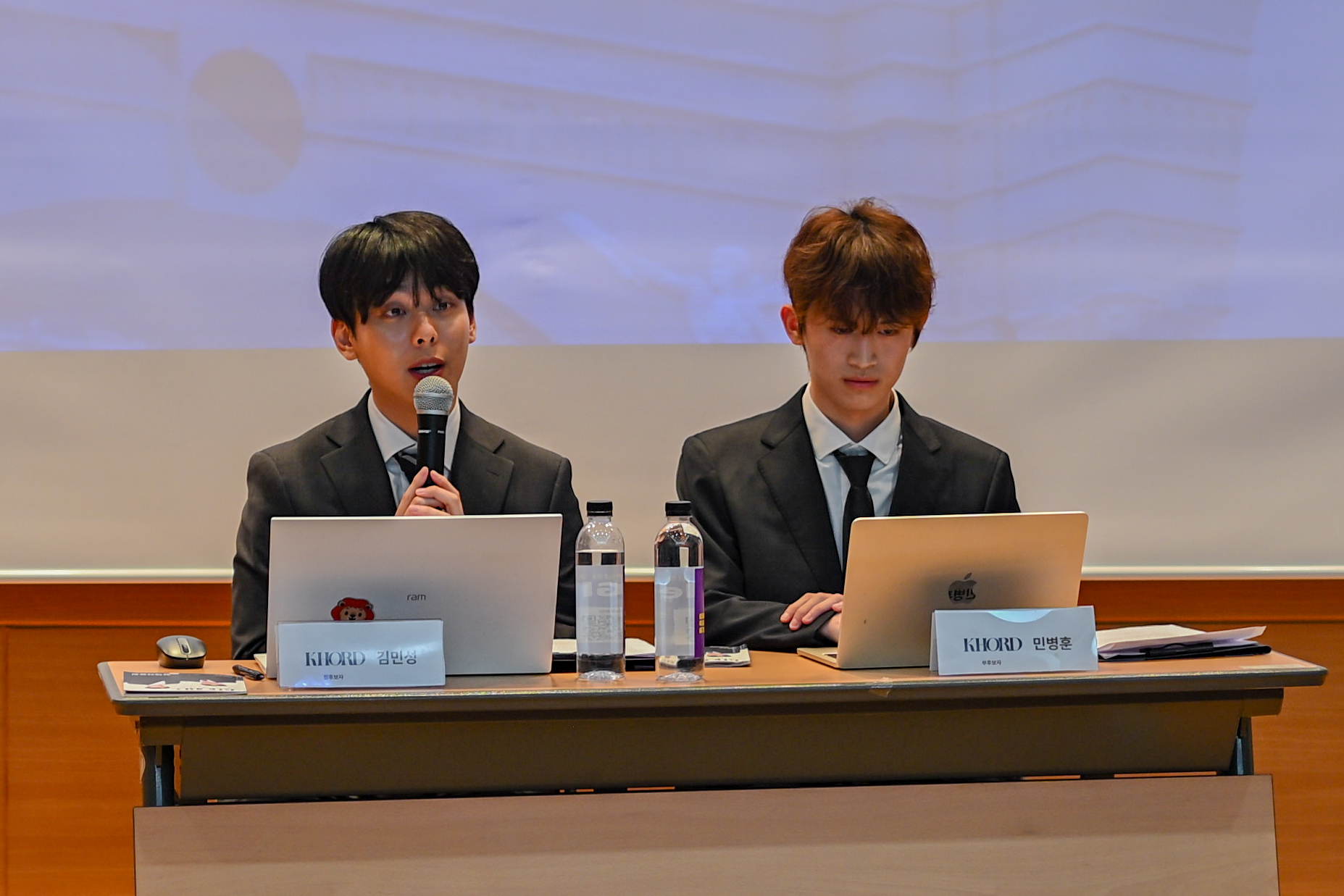
On November 16, a candidate public hearing was held ahead of the election for the 59th Global Campus General Student Association (GSA) in Room 106 of the College of Management and International Relations Building. The hearing included an opening remarks, policy speech, media inquiries, and additional Q&A.
Key Pledges Include Direct Election of the President and Course Registration Reform
At the hearing, KHORD presented several key pledges: pursuing a direct election of the President, with student votes making up 25% of the overall result; preventing the unilateral enforcement of the course registration mileage system; pushing for large-scale restructuring of academic units; and introducing absolute grading for all general education courses.
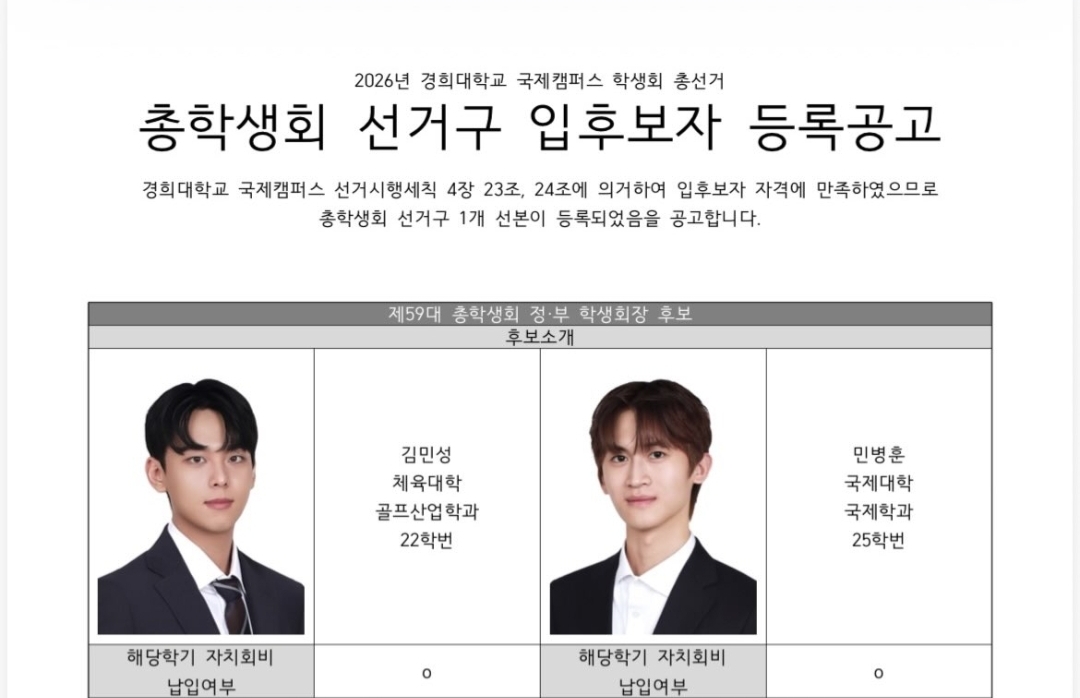
On the selection of the President, GSA presidential candidate Kim Min-seong said, “The direction the President sets for education and finances affects what classes students can take and what support they can receive.” He explained that students should have a role in selecting the President. KHORD said it would seek to make student votes account for 25% of the overall result. Under its proposed system, voting results from each group within the University would be combined to determine the top-ranked candidate. In principle, the board of trustees would then appoint that candidate as the President.

Photo by Oh, Eun-je | The University Life
In academic affairs, KHORD said it would prevent the unilateral enforcement of the course registration mileage system and work to reduce the burden on students. The system, set to begin in the first semester of the 2027 academic year, allows students to assign mileage points to the courses they want to take. If applications exceed the number of available seats, 30% of the seats will be allocated in advance to students who assign the most mileage points to the course. The remaining seats will be filled through the existing first-come, first-served process. KHORD said students who are not selected in advance must prepare to apply again during first-come, first-served registration, adding to their burden. It said it would call for a larger share of seats to be allocated in advance and better rules for choosing among students with the same mileage score.
KHORD also proposed introducing absolute grading for all general education courses. It said students should be able to explore subjects freely without giving up courses that interest them because of concerns about grades. The campaign team said it would discuss with the University how to establish achievement standards for each course and address concerns about grade inflation, while respecting instructors' authority to assess students.
Other pledges included protecting students’ rights regarding generative AI use, allowing students to participate in exchange programs during the second semester of their fourth year, reducing brokerage fees through partnerships with nearby real estate agencies, and supporting students who miss classes due to reserve forces training.
Q&A Examines the Basis for Pledges and How They Would Be Carried Out
During the Q&A, a question was raised about whether KHORD needed a plan to increase student turnout before seeking a larger share for student votes in the presidential election, given low participation in previous elections for student representative bodies. GSA presidential candidate Kim Min-seong replied that encouraging students to take an interest in the presidential election was the GSA's responsibility. He added that KHORD would convey issues students care about to the presidential candidates and make their policy responses easy for students to access. If elected, the team would form a task force on the direct election of the President as soon as its term began.
Another question concerned the proposal to introduce absolute grading for all general education courses, an issue raised in previous GSA elections. The question asked how KHORD would address differences of opinion between the two campuses and among faculty members. GSA vice-presidential candidate Min Byung-hoon replied, "We will emphasize that moving to absolute grading would restore professors' autonomy in assigning grades." Min said he would provide a chart showing grading standards for instructors to use as a common reference. This would help prevent assessment standards from varying too widely among instructors. He also said he would seek to prevent assessment criteria from being changed arbitrarily after course syllabi are finalized and to establish an official channel through which students can appeal their grades.
A further question asked whether KHORD had held advance discussions about what would be needed to carry out its pledges. KHORD said it had consulted with Seoul Campus GSA about the presidential selection system, tuition review procedures, and absolute grading for all general education courses. It also mentioned communication with the University offices and the board of trustees, but did not share specific details, saying that disclosing details that had not yet been finalized could cause confusion.

Photo by Oh, Eun-je | The University Life
In its opening remarks, KHORD said that students may have different hopes for the University and different views on its policies, adding, "We believe student representatives' work should begin with understanding those differences."
Voting will take place entirely online from November 23 to 25, with voting open from 9:30 a.m. to 6 p.m. each day. With only one campaign team running in this GSA election, attention is focused on whether turnout will reach the 50% required for the election to be valid.
There are no registered comments.
- 1
- 2
- 3
- 4
- 5


I agree to the collection of personal information. [view]