

[Campus] How Has the Once-Flooded Reference Reading Room Changed in a Year?
To learn more about how the library has changed
● Risks: Inside the Crisis at the Global Campus Central Library

Reading room in the Global Campus Central Library
The 30-year-old water leak problem in the reading room of Kyung Hee University's Global Campus Central Library has finally taken its first step toward resolution, with the interior waterproofing wrapped up at the end of August. A space where student workers spent last year pumping out rainwater with a water pump now has, at last, the foundation to become a proper study environment. With full-scale construction scheduled for December and a reopening planned for February of next year, attention is turning to whether this overhaul can finally break the cycle of temporary fixes—and become a real turning point for students.
Thirty Years of Leaks: Not Just an Inconvenience, but a Threat
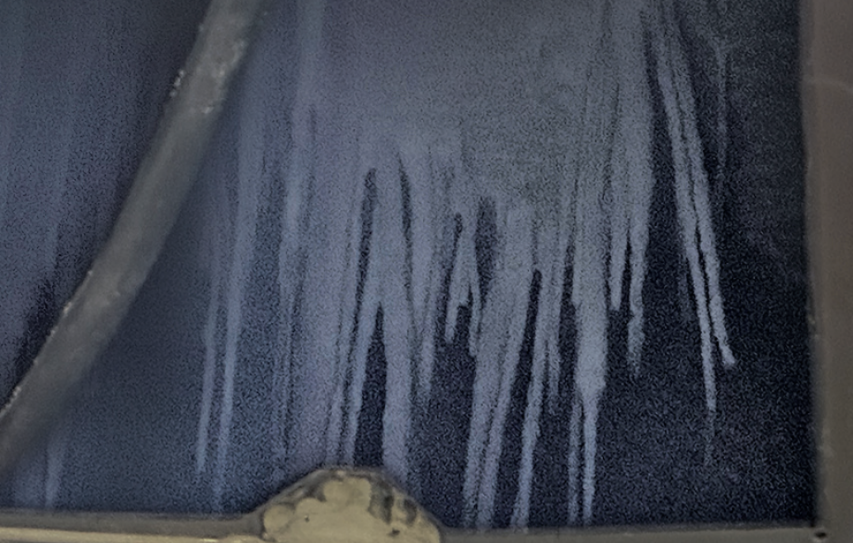
Since the library opened in 1995, the leak in the reading room had never once been addressed at its root. Rainwater seeping beneath the exterior marble drained into the pipes and left behind sludge, substances like mud and debris, that clogged the pipes, sent water spilling from ceilings across the room, and eroded the walls. The damage was worst beneath the first-floor entrance, where contaminated water dripped down and hardened into stalactite-like formations.
While conditions deteriorated, the library's response stayed at the level of patchwork. Water dripping from the ceiling was caught in buckets and pumped out. Metal plates were bolted over damaged ceiling sections. Large plastic sheets were draped over the book storage areas to keep the rain off the collection. On rainy days, student workers were left mopping puddles into piles and vacuuming them out with wet vacuums.
The setup was more than uncomfortable—it was hazardous. Water pumps running all day produced constant noise inside the reading room, and water at times reached the very desks where students were trying to study. Books stored near the leak points sat under a permanent risk of damage. Most critically, humidity bred mold and degraded indoor air quality, putting the breathing health of student workers and long-hour library users at risk.

End of Patchwork: Real Waterproofing with Drills and Injected Sealant
About nine months after this publication first reported on the leak in November of last year, interior waterproofing in the reading room was completed at the end of August. Seo Su-hwan, head of the Academic Services Team, explained that “even as recently as last year, no contractor or timeline had been fixed, so it was unclear whether the project would move forward at all. Concrete planning only began in April of this year.” Investigation of the leak sources and intensive inspections followed through the summer break—from June to August—before the interior waterproofing was wrapped up.
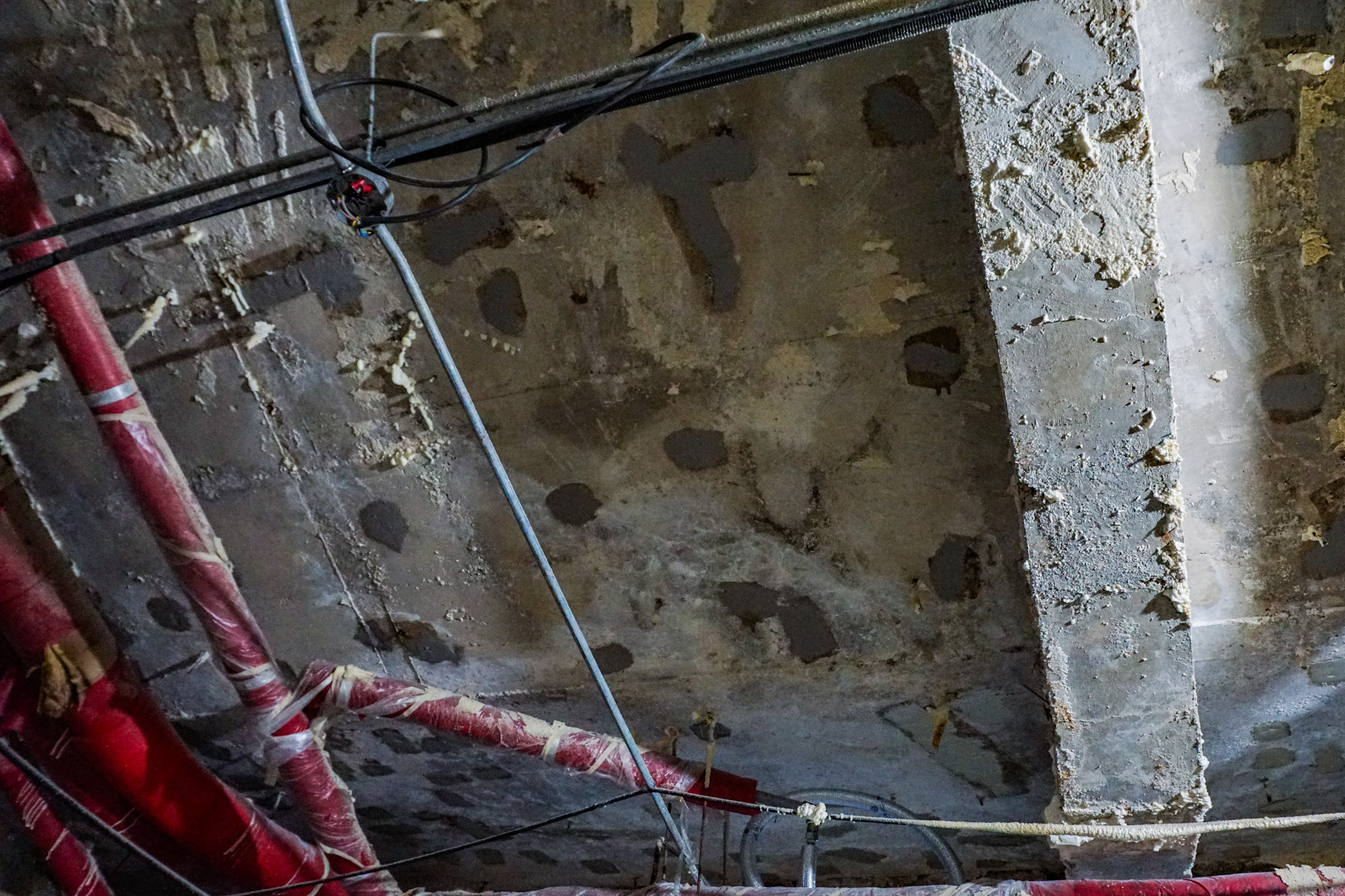
The project used an “injection waterproofing” method, in which holes are drilled through the ceiling, and a chemical sealant is injected. The sealant travels along moisture pathways and then hardens, cutting off the leak at its source. Unlike past surface-level fixes—replacing metal plates or hanging plastic sheeting—this approach targeted the leak pathways themselves. The dense clusters of drill marks left across the ceiling give a sense of just how thorough the work was.
 The marks indicate the construction areas; specifically, the grey marks show where the substance was injected into the ceiling
However, the completion of interior work alone is no cause for relief. Seo added, “We have only just finished construction, and additional repairs may be needed after the building endures the upcoming rain and snow in autumn and winter. For now, we are still in the stage of watching how it holds up." Exterior waterproofing—covering the corridor outside the first-floor entrance and the smoking area—is also still underway, leaving a full seal against water as the remaining task.
Beyond Waterproofing: A Full Remodel Aimed at February Reopening
The project is part of the second year of the University Innovation Support Program, a three-year initiative. The Hyeyum Reading Room on the second floor, along with other spaces improved last year, fell under the first-year project. In this second year, every accessible space inside the reading room is on the remodel list.
Seo stressed that the waterproofing work is the foundation of the remodel. “There is nothing we can do if we do not fix the leaks—without waterproofing as the first step, no subsequent remodeling can be effective,” he said. “This waterproofing project was a necessary first step for the full construction work ahead, and now it is time to genuinely transform the space.”
The full renovation of the reading room is targeting completion by February 2027. The library will first carry out book selection, relocation, and rearrangement work from September through November. Seo noted, "We are adjusting the size and placement of the collection to give students a more convenient, comfortable, and efficient flow through the space," and stated the library's intent to "build a reading environment that reflects student needs as much as possible." From December, full-scale construction begins—tearing down the temporary partition walls installed for the waterproofing work and redesigning the space from the ground up.
 The Second Preservation Archive, which suffered from severe water leakage, is now under construction in preparation for future renovations.
Change at the library will not stop with the reading room. According to Seo, the third year of the program will focus on spaces not addressed in the first two. A comprehensive remodel of the First Reading Room—desks, chairs, and flooring—is currently under serious consideration. However, no specific details have been locked in yet, and there remains room for the scope to expand or shift to spaces beyond the First Reading Room as further discussions unfold.
The reading room, which suffered for so long on temporary fixes, has finally taken a meaningful first step: cutting off the leak pathways at their source. Yet with exterior work still underway and the test of autumn and winter rain and snow still ahead, whether this marks a complete resolution can only be determined when the room reopens next February. Now, the focus turns to how the newly reopened reading room will shape the student experience.
- 1
- 2
- 3
- 4
- 5

I agree to the collection of personal information. [view]