
[People] Prof. Son Seok-kyun and the Road from Quantum Science to Society
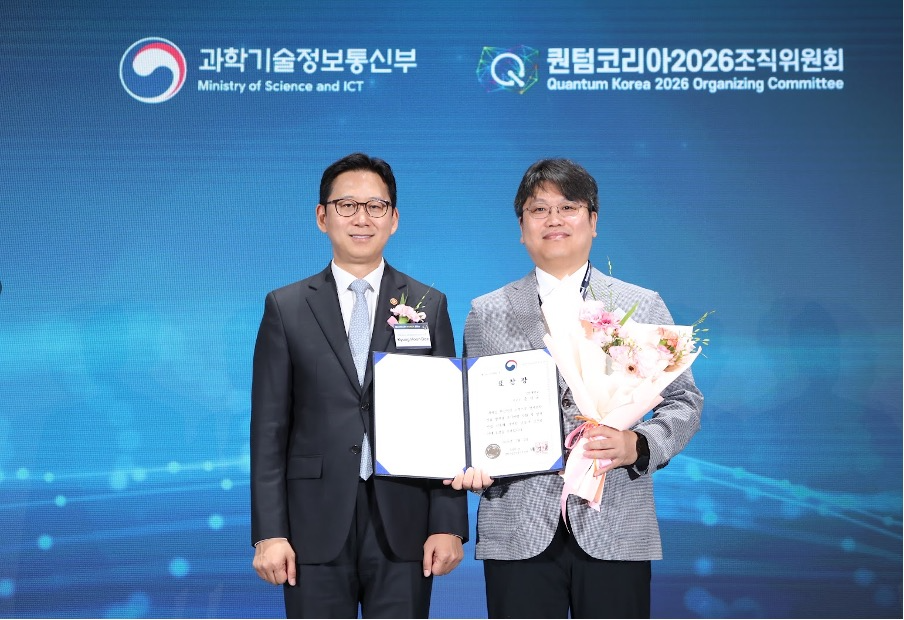
Professor Son Seok-Kyun of the Dept. of Physics at Kyung Hee University (KHU) received the Deputy Prime Minister, Minister of Science and ICT’s Commendation for Contributions to the Advancement of Quantum Science and Technology on July 2. The award recognized his contributions to advancing quantum science and technology and fostering the research ecosystem.

Prof. Son Seok-kyun receives the Minister of Science and ICT’s Commendation at Quantum Korea 2026 on July 2.
Courtesy of Prof. Son Seok-kyun
Hosted by the Ministry of Science and ICT, Quantum Korea 2026 is Korea’s largest event in the field of quantum technology. Experts from Korea and abroad gather at the event to share the latest research achievements and industry trends in quantum technology while discussing ways to strengthen global cooperation.
From Fundamental Science to Future Technology
For Prof. Son, physics is a field that explains natural phenomena through the most fundamental laws of nature, and his curiosity about these laws naturally led him to become a researcher.
Early in his career, he focused on fundamental research to understand new quantum materials and the behavior of electrons. However, as he conducted research on semiconductors, 2D materials and quantum devices, his perspective gradually broadened.
He began to think beyond discovering new phenomena and consider how those discoveries could create value for society, marking a major turning point in his career as a researcher. After witnessing firsthand how ideas originating from fundamental science could lead to future technologies, Son turned his attention to quantum information science.
“I see different research fields not as separate areas, but as parts of a single flow,” Son said, explaining that his research across solid-state physics, semiconductor physics and quantum information science is united by a single vision—to understand and control quantum phenomena and apply them to future technologies.
He is now expanding the scope of quantum technology through its integration with fields such as biotechnology, medicine, semiconductors and AI, opening up potential applications across a wider range of disciplines.
Building Quantum Technology Step by Step
Prof. Son’s research philosophy is also reflected in the projects his team is currently conducting. These include the Limit-challenging R&D Project, which aims to establish core technologies for future quantum devices, and the Quantum Science and Technology Flagship Project, focusing on building a next-generation quantum sensing platform for biomedical applications.
Through these projects, the team is working on single-photon emitters, which play a key role in quantum devices, and studying quantum communication technologies that can stably generate and control quantum states. Based on this work in quantum communication, the team is also designing next-generation quantum sensors capable of measuring quantum states with greater precision. This year, the research has expanded further into the application of this technology in the biomedical field.
The goal is to develop a quantum sensing platform that can analyze biological signals with extremely high sensitivity, which are difficult to measure with conventional technologies.
“This research is possible because communication, quantum sensing and quantum computing are not independent technologies. They all rely on the same fundamental capabilities: generating, controlling and measuring quantum states,” he explained.
Prof. Son said, “Experience and knowledge gained from one technology naturally contribute to advances in another.” He added that the projects do not represent repeated changes in research topics, but rather reflect team’s step by step advancement along the long-term research roadmap.
Ultimately, these efforts are intended to create a research ecosystem that begins with quantum materials, advances to quantum devices and eventually extends to further technologies.
Creating a Quantum Research Ecosystem
To further strengthen this ecosystem, the team is also pursuing the Quantum Platform Development Project, which focuses on building the infrastructure needed to support broader collaboration and applications in quantum technology.
Regarding the ongoing projects, Prof. Son said that once these fundamental technologies are established, they could lead to new applications not only in medicine but also in industries such as semiconductors, energy and AI.
However, bringing these technologies into practical use requires more than just quantum research alone. Researchers and companies from a wide range of fields, including physics, medicine, life sciences, semiconductors, information and communications technology and AI, must work together.
To support such cooperation, the research team is establishing an Open Quantum Fab centered at KHU, which will provide infrastructure for researchers and companies to jointly develop and test quantum devices.
Prof. Son is also expanding international cooperation, including joint research with Professor Konstantin S. Novoselov, a recipient of the 2010 Nobel Prize in Physics. At the same time, he is working with the global quantum computing company Pasqal and Korean industry partners to expand the practical applications of their research.

Prof. Son Seok-kyun (left) with Prof. Konstantin S. Novoselov, a recipient of the 2010 Nobel Prize in Physics.
Courtesy of Prof. Son Seok-kyun
Another major goal is creating an environment where young researchers can take on world-class research challenges.
“I believe the biggest change in quantum technology will be its transition from technology inside the laboratory to technology used in society,” Son said. “To achieve this, I will continue to expand cooperation with leading research institutions and companies around the world through KHU’s Global Research Institute for Quantum Materials and work to build a research ecosystem that connects fundamental research with industrial applications.”
These efforts in research and cooperation also contributed to Prof. Son’s recent commendation. He believes the award recognized not one particular research achievement, but his broader efforts ranging from fundamental research and international cooperation to research infrastructure and the development of a quantum technology ecosystem.
He sees the award as both an encouragement and a responsibility for his team to take on greater challenges. He also expressed his gratitude to all members of the Hybrid Quantum Systems Laboratory in KHU Dept. of Physics.
For Son, the commendation represents not only what his team has achieved so far, but also the direction he hopes to continue pursuing: creating greater social value through research and collaboration.
People often focus on visible achievements and final results in science. For Prof. Son, however, 99.9% of the research process consists of results that do not turn out as expected.
“Still, I do not want to call that a failure,” he said. “It simply means that the result was different from what we initially expected.”
Prof. Son emphasized that what matters most is what researchers do after obtaining an unexpected result. Rather than giving up on the data, researchers must search for a new meaning within it, and this process can eventually lead to new and meaningful discoveries.
This idea also shapes the advice he gives to students. Rather than being overly affected by immediate success or failure, he hopes students will remain curious and view setbacks and trial and error as opportunities to learn.
“I believe university years are the best time to develop these abilities. I hope students do not limit their own possibilities.”
Rickyfrimi님의 댓글
<a href=https://mediavox.com.ua/1965-rik-iakoi-tvaryny-za-skhidnym-kalendarem-rik-derevianoi-zmii-ta-ii-kharakterystyka/>https://mediavox.com.ua/1965-rik-iakoi-tvaryny-za-skhidnym-kalendarem-rik-derevianoi-zmii-ta-ii-kharakterystyka/</a>
Jamesnug님의 댓글
Актуальный рейтинг клиник <a href=https://лучшие-клиники-лечения-геморроя.рф/>https://лучшие-клиники-лечения-геморроя.рф</a> по лечению геморроя на 2026 год. В подборке — медицинские центры с опытными проктологами, современными методами диагностики и лечения, отзывами пациентов и информацией о стоимости процедур.
- 1
- 2
- 3
- 4
- 5



I agree to the collection of personal information. [view]