

[Culture] Reading Beyond Walls: How Seoul Metropolitan Library Builds Civic Connection
Have you ever seen people reading books on a green lawn, in the heart of downtown Seoul? At Seoul Metropolitan Library (SML), located in Jung-gu, this striking scene has become increasingly familiar. Blending a century-old white stone exterior with a modern interior, the library reflects Seoul’s modern history. Today, it also promotes democratic values through various innovative programs that challenge stereotypes of libraries and provide citizens spaces for dialogue. This article explores SML as a civic space defined not only by silence, but also by meaningful communication.
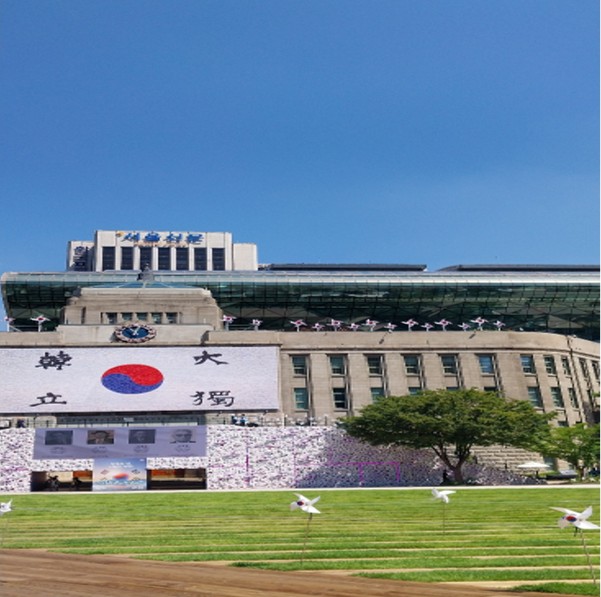
SML and Seoul Plaza
The Democratic Value of Seoul Metropolitan Library
The library began a century ago as a simple white building. Originally, it functioned as the Gyeongseong-bu Administration Office, part of the colonial government during the Japanese occupation. Following liberation, the building was repurposed as Seoul City Hall in 1946, becoming the seat of the Seoul Metropolitan Government in an independent Korea.
In 2012, after debates over whether the building should continue to be used or be demolished, it was transformed into the public library citizens use today. Once a possession of colonial authority, SML has become the symbol of South Korea’s transition into a democratic society. Furthermore, beyond its historical significance, today it seeks to serve as a leading space for civic engagement.
The library’s current vision is closely tied to democracy, especially the concept of the public sphere. According to Jürgen Habermas, the modern philosopher who developed this concept, the public sphere is a space where citizens can freely and rationally discuss matters of public interest, independent of state power. Considering ongoing conflicts and humanitarian crises around the world, the role of the public sphere in preserving democratic values has become more important than ever.
Oh Ji-eun, who has served as director of the SML since 2022, has stated that “Libraries need to become public spheres growing with society, not merely enhancing individual capacity.” Under her leadership, SML has been running a range of programs aimed at creating a public sphere for civil society. Two major initiatives reflect this goal: Seoul Outdoor Library and Hipdok Club.
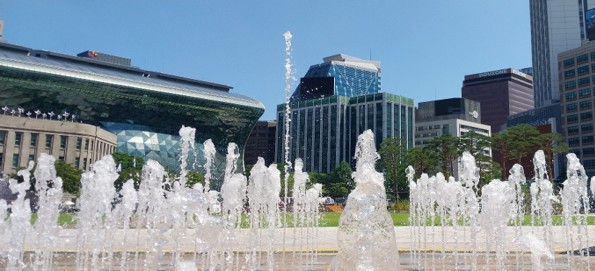
Fountain at Seoul Plaza
Seoul Outdoor Library, an Open Public Sphere for Civic Participation
The Seoul Outdoor Library program is one of the world’s first outdoor library programs. It began in 2022 at Seoul Plaza, located in front of the library. In this space, citizens can gather on the grass and read books on various themes. The books provided by the library are divided into three pick zones: emotion, together, and refresh. These selections have been carefully chosen by SML librarians based on their relevance and significance.
The program is scheduled to run from May 1 to June 28 and from September 4 to November 1. During each period, it will be open every Friday, Saturday, and Sunday from 11 a.m. to 6 p.m. Since the program takes place outdoors, its schedule may change depending on weather conditions or other events. To encourage open participation, no prior registration or application is required.
This program is particularly notable because it redefines the traditional concept of a library. Instead of being a place only for silence and individual study, the library becomes an open civic space where visitors can read and converse freely. This presents an opportunity for university students to step outside of routine campus life and take part in discussions on various issues in their spare time. International students are also welcome to visit and participate in this public space for global civic exchange.
Reflecting public satisfaction with the program, Seoul Outdoor Library was selected as the No. 1 policy in the 2025 Seoul Top 10 News citizen vote, in which citizens were asked to choose Seoul’s most attractive policies. A total of 226,062 citizens participated in the vote, with 112,762 voting for this policy. The results highlight what citizens value: a public space that supports both leisure and civic engagement.
Hipdok Club, a Hybrid Reading Community for Busy Readers
Hipdok Club is another distinctive program organized by SML. Its name reflects its unique identity as a hybrid reading community. Launched in 2025, the annual program recruits members in early April. This year, Hipdok Club recruited 10,000 citizens aged 14 or older who have an interest in reading, starting on April 1. Membership remains valid until December 31.
Unlike many clubs that require membership fees, the program is free of charge. It also offers book purchasing support through Seoul Pay+, the program’s partner mobile app. In addition, the program includes various events: such as discussions on “brick books” to encourage people to read difficult works, meetings with international authors, and nomad reading events that take place in distinctive outdoor locations across the country.
An SML official said that members can be connected by a light sense of solidarity, rather than by the close-knit relationships typical of traditional book clubs. This structure allows busy readers to move away from programs that pressure them to attend regularly and instead encourages flexible participation in a wide range of public discussions.
In 2025, the first year of the book club, registration filled up just two hours after opening. This year, the club reached full capacity in just seven minutes. This rapid response demonstrates how strongly citizens desire spaces where they can read together and suggests that there is still high demand for public policies that create opportunities for civic communication.
SML holds significance as an idea of democracy. Its value lies in its historical transformation from an exclusive space for the powerful into a public space for everyone. The library also reflects Habermas’s idea of the public sphere by creating participatory programs such as Seoul Outdoor Library and Hipdok Club. In an uncertain world, SML serves as a place where citizens can engage in public discourse and renew their public attention to democratic values.
There are no registered comments.
I agree to the collection of personal information. [view]